

Maybe America will come. Maybe it’ll come in time. Maybe it’ll come all the way—or maybe slowly, selectively, with a debate and a price tag attached first. For seventy-five years, Europe never had to finish that sentence. Now it can’t stop hearing it. What follows is the story of what Europe is quietly building in the space where certainty used to sit—and why every “maybe” is a crack an adversary only has to widen.
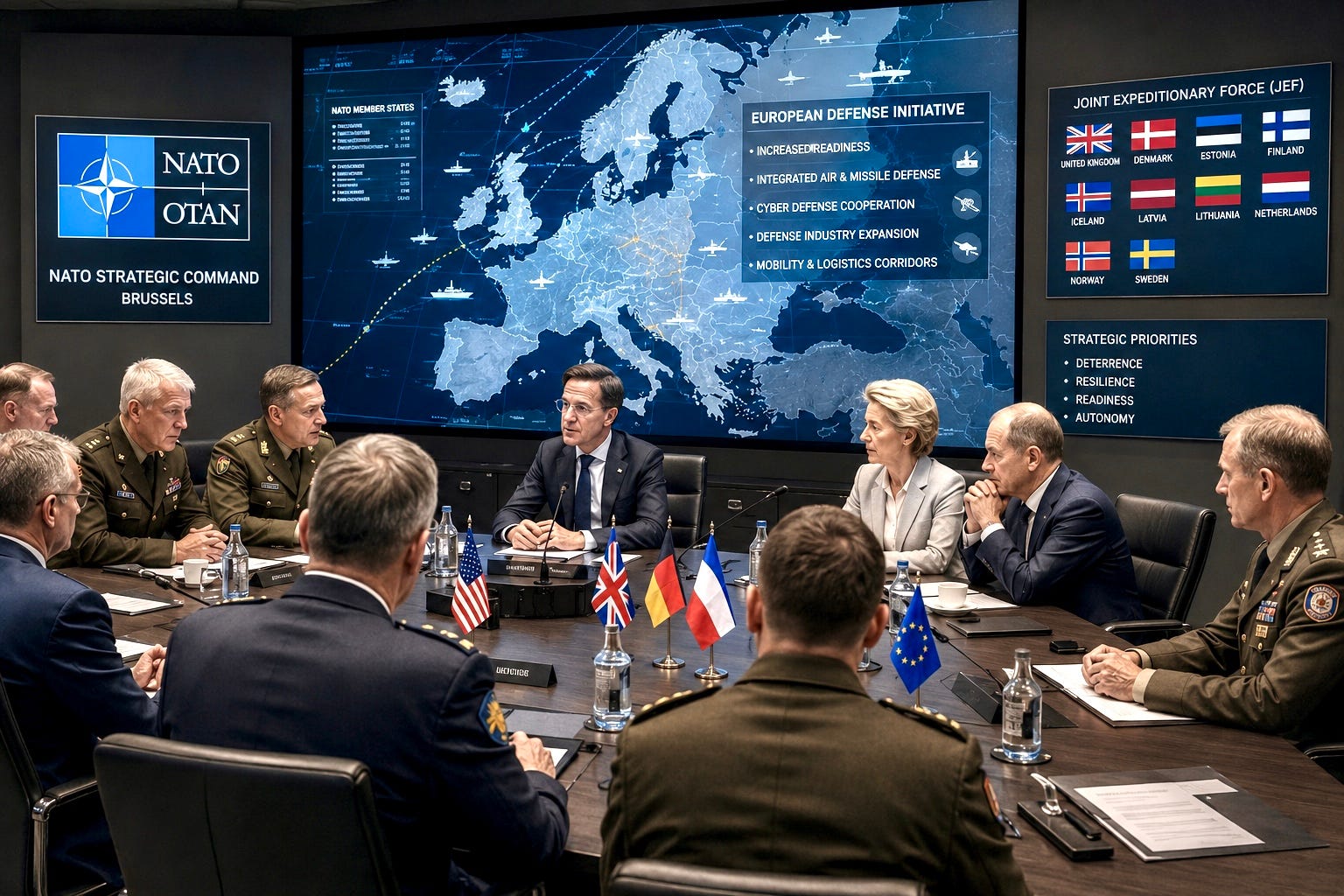
Think of it as a flexible emergency framework: preserve NATO if possible, Europeanize it if necessary, and bypass paralysis entirely if Washington ever becomes unreliable, obstructive, or absent.
What has quietly changed inside Europe over the last three years isn’t just defense spending—it’s psychological. For the first time since 1949, major European governments are seriously contemplating a future in which the United States might not automatically defend Europe during a crisis—or might do so selectively, conditionally, slowly, or transactionally.
That realization has initiated the largest overhaul of European defense strategy since the Cold War.
The main issue isn’t just the number of American troops. Europe’s reliance on the United States is woven into nearly every part of NATO’s system: command-and-control, strategic intelligence, satellite reconnaissance, cyber integration, airlift, logistics, missile defense, nuclear deterrence, precision targeting, and the American four-star general who usually serves as NATO’s Supreme Allied Commander Europe (SACEUR). NATO was built around strong American support. If the United States were to withdraw, the alliance wouldn’t just shrink; it could lose the core connection that allows the system to operate quickly during wartime.
European leaders are increasingly realizing that this is no longer just a theory.
Donald Trump has repeatedly questioned NATO’s collective-defense obligations, openly suggested that allies failing to meet spending targets might not be protected, and privately alarmed European officials with talk of reducing American commitments to the alliance. Reuters has reported that Washington is considering shrinking the pool of US forces designated for NATO crisis response. Meanwhile, European intelligence agencies increasingly believe that future American administrations—Republican or otherwise—may prioritize Asia and China containment over European security. The result is a quiet but accelerating strategic reassessment across the continent.
The emerging European answer breaks into several overlapping tracks.
First, Europe is working to make NATO less reliant on the United States while keeping NATO itself as the main framework. NATO Secretary General Mark Rutte has carefully described possible American force reductions as manageable and gradual instead of catastrophic, mainly to prevent panic within the alliance. However, behind the scenes, NATO planners have already started giving more operational responsibility to European commanders. European officers are taking on bigger roles in logistics coordination, regional planning, and quick-response setups. Quiet contingency exercises are also testing how NATO command chains might operate if American political leaders hesitate during a crisis.
The reason is simple: European governments no longer fully trust political continuity in Washington.
Second, Europe is rearming at a speed unseen in generations.
NATO’s 2026 defense-spending assessments show that European allies and Canada increased military spending by roughly 20% over 2024 levels after allies endorsed a move toward a 5% combined defense-and-security spending target. But the significance isn’t the money itself. The deeper story is what that money is buying.
Europe is shifting from a “peace dividend” defense model to a war-readiness model.
Poland is developing what could soon become the largest land force in the European Union. It’s purchasing South Korean K2 tanks and K9 artillery, American HIMARS systems, Apache helicopters, Patriot missile defense systems, and building large ammunition stocks at an extraordinary rate. The Baltic states are strengthening borders, building anti-vehicle barriers, enhancing drone warfare capabilities, and mining key defensive routes. Finland and Sweden joining NATO has radically changed the strategic landscape of Northern Europe, turning the Baltic Sea into what NATO planners increasingly see as a near-allied operational zone.
Germany’s transformation might ultimately be the most significant of all.
For decades, Berlin served as Europe’s economic powerhouse but maintained a minimalist military stance. That era is ending. Chancellor Olaf Scholz’s “Zeitenwende,” or historic turning point, triggered a €100 billion special defense fund and started reversing decades of military neglect. Germany is boosting ammunition production, rebuilding armored units, upgrading air defenses, and positioning itself as Europe’s industrial backbone for defense. Rheinmetall, once a symbol of Europe’s stagnant defense sector, is now expanding production lines across multiple countries in anticipation of long-term continental rearmament.
The EU itself is becoming more militarized financially.
Brussels is increasingly relying on collective financing mechanisms to support arms manufacturing, cross-border mobility infrastructure, ammunition procurement, cyber defense, and defense-industrial integration. The European Commission has started discussing defense production in areas once reserved for energy security or pandemic supply chains. Europe is gradually realizing that industrial capacity—more than just troop numbers—determines whether deterrence can survive a prolonged conflict.
Third, Europe’s likely initial fighting core is becoming clearer.
If Russia tested NATO through a Baltic incursion, a hybrid attack, an infrastructure strike, or a border escalation, the countries most likely to respond immediately would be Poland, Estonia, Latvia, Lithuania, Finland, Sweden, Britain, and possibly France. Germany would almost certainly be quickly involved if NATO assets in the region were targeted.
The logic is direct but harsh: frontline states cannot afford to wait through delay politics.
The biggest concern in Eastern Europe isn’t necessarily outright American abandonment. It’s hesitation. A delay in triggering Article 5 within the North Atlantic Council during the initial hours of a crisis could create the uncertainty Russia would want to exploit. That’s why regional military planning increasingly emphasizes “fight tonight” readiness, regardless of alliance-wide consensus procedures.
That’s also why the British-led Joint Expeditionary Force (JEF) matters so much.
The JEF—which includes Britain, Denmark, Estonia, Finland, Iceland, Latvia, Lithuania, the Netherlands, Norway, and Sweden—has quietly developed into one of Europe’s most vital fallback options. Unlike NATO, it doesn’t need unanimous approval from 32 member states before taking action. It was designed for quick northern European crisis response, gray-zone conflict, maritime security operations, infrastructure defense, and fast military coordination.
Its appeal is both political and military: speed outweighs bureaucracy.
In many ways, the JEF increasingly resembles a prototype for how Europe might respond in the early stages of a future crisis—smaller coalitions of highly aligned states acting quickly. Simultaneously, larger alliance structures are catching up behind them.
Furthermore, Europe is developing regional defense “capability blocks” aimed at reducing dependence on American systems gradually.
Germany’s European Sky Shield Initiative aims to build a continent-wide, integrated air and missile defense system using layered systems such as Patriot, IRIS-T, and Arrow-3 interceptors. Nordic and Baltic countries are incorporating maritime surveillance, anti-submarine warfare, and Arctic operational planning. Poland and the Baltics are quickly adopting lessons from Ukraine, focusing on drones, electronic warfare, hardened logistics, dispersed command systems, and large ammunition stockpiles.
The Ukraine war has significantly sped up all of these developments.
European military planners have observed Ukraine reveal the realities of modern industrial warfare: heavy artillery use, drone saturation, electronic warfare interference, supply chain weaknesses, and the alarming speed at which ammunition reserves vanish during prolonged combat. One of NATO’s greatest fears is that many European armies could run out of key munitions within days or weeks of a major conflict. This fear now drives urgent efforts to increase shell production, missile manufacturing, and defense-industry coordination.
The nuclear question underlies all of this.
For seventy-five years, Europe’s primary deterrent has heavily relied on the American nuclear umbrella. If trust in that umbrella diminishes, Europe faces difficult questions. France has an independent nuclear arsenal, and Britain maintains a submarine-based deterrent connected with American systems. Quiet talks are already beginning about whether French and British nuclear forces might eventually serve as a broader European deterrent if confidence in Washington declines further.
That discussion would once have been politically unthinkable. Now it’s simply sensitive. However, Europe’s vulnerabilities remain substantial.
Despite increased spending, Europe still lacks adequate strategic airlift, ISR (intelligence, surveillance, and reconnaissance), missile defense depth, long-range strike capabilities, deployable heavy brigades, secure battlefield networking, and integrated wartime command capabilities. American military logistics are so deeply embedded within NATO that replacing them would take years, even in an emergency.
Britain maintains operational credibility and expeditionary experience but lacks military mass due to years of budget constraints. France has nuclear credibility and intervention capabilities but often pushes European strategic autonomy in ways that make smaller allies nervous. Germany has the industrial and financial capacity to support European defense but still struggles with procurement delays, readiness gaps, and bureaucratic inertia. Poland might become Europe’s strongest continental army, but it cannot replicate America’s global support systems on its own. And looming over everything is time.
Russia doesn’t need to defeat Europe militarily to create instability. It only needs to persuade Europeans that America’s commitment has become uncertain enough to weaken deterrence psychologically. That’s the strategic rupture now emerging beneath the surface of transatlantic politics.
For generations, Europe’s assumption was simple: America might complain, negotiate aggressively, or demand more spending—but when a crisis emerged, America would be there.
That assumption is fading. The new assumption is colder, harder, and much more dangerous: Europe must be prepared to fight first, organize quickly, and survive long enough without knowing if Washington will fully commit.
That changes everything. A deterrent built on certainty is powerful. A deterrent built on ambiguity invites testing.
And a deterrent built on “maybe” is no deterrent at all.
Excellent background layout here, Keith.You really did your homework. To bad trump is a Russian wannabe, otherwise we could have supported Ukraine,had them join NATO to strengthen our alliance's, Delivered the weapons paid for by Taiwan, Never had gone to war with Iran ,that kept the shipping lanes opened, Venezuela's coastal waters would still be safe as well as their Oil, Greenland wouldn't be on the chopping block... Cuba etc.on and on and...😖 Good job tonight, Thank you. TGIF to you, hoping you have a great Memorial day weekend, and will reStack ASAP 💙 💯👍