
The AI Grid Tax
How America’s artificial intelligence boom may quietly become a household utility crisis

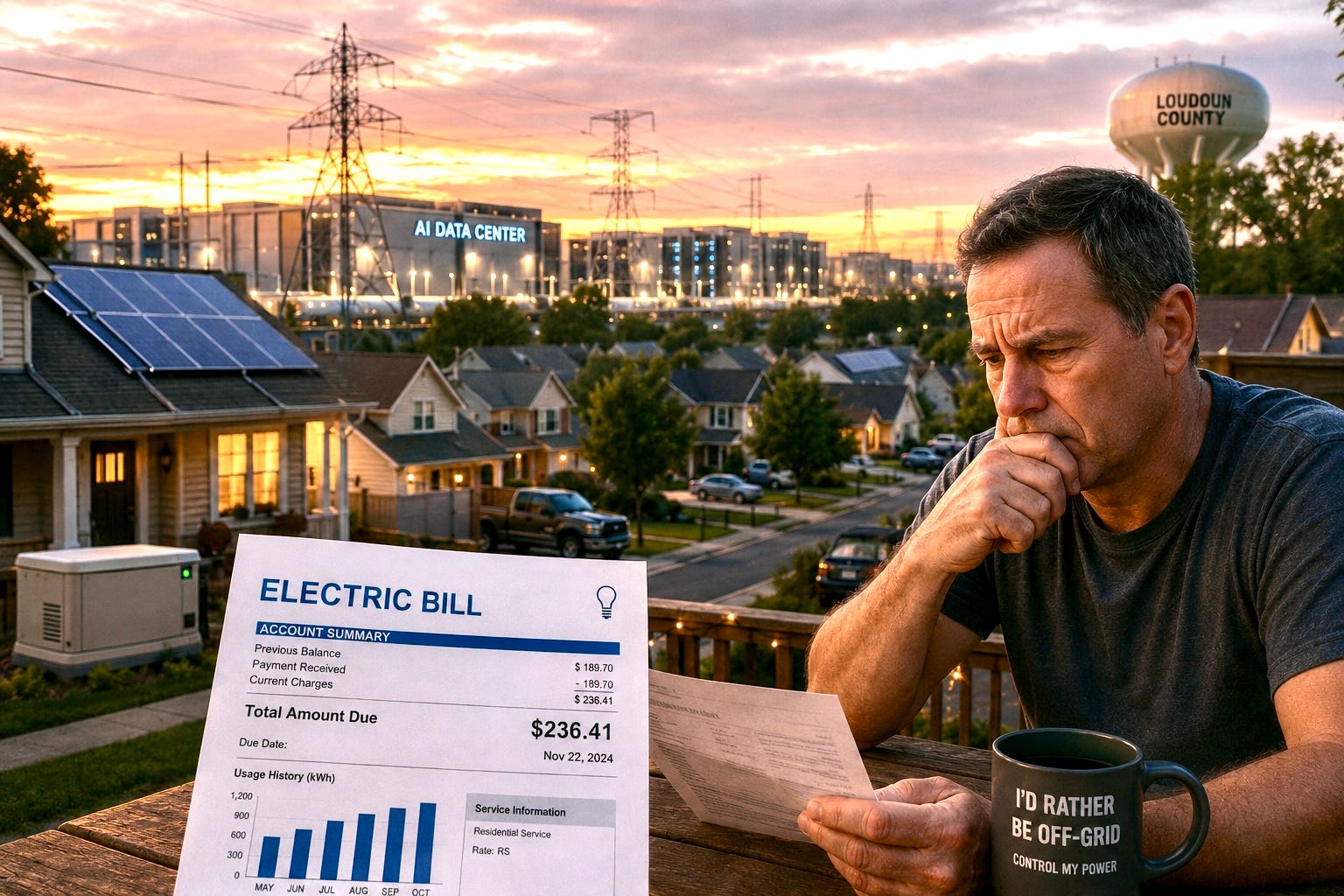
The future is arriving disguised as an electric bill.
Most Americans still see artificial intelligence as something almost weightless. A chatbot answers questions. An image generator creates artwork in seconds. A company automates reports that once took teams of employees days to produce. Investors celebrate another surge in technology stocks. Politicians declare an “AI race” against China. The language around artificial intelligence is filled with abstractions: innovation, productivity, disruption, transformation.
But AI isn’t just abstract infrastructure—it’s concrete infrastructure, and more and more, it’s electrical infrastructure on a scale the modern American grid was never built to handle.
Behind every AI-generated image, every large-language-model query, every autonomous workflow, and every corporate “AI strategy” is a vast physical infrastructure of hyperscale data centers filled with heat-producing processors that consume enormous amounts of electricity. The cloud is not just a cloud. It consists of warehouses, transformers, cooling systems, transmission lines, water usage, substations, backup generators, fiber corridors, land acquisitions—massive industrial demands operating constantly on already strained electrical systems.
And someone has to pay for all of it.
The increasingly uncomfortable question surfacing within utility commissions, regional grid operators, and local communities across the United States is whether ordinary Americans are quietly being asked to subsidize a significant portion of the infrastructure needed for the AI revolution—not through taxes but through higher utility bills. That issue has barely entered the national conversation, and it could eventually become one of the most important political and economic conflicts of the AI era.
The best indication of that future lies within a little-known organization most Americans have never heard of: PJM Interconnection.
PJM manages the largest electric grid in North America, coordinating electricity transmission across much of the Mid-Atlantic and Midwest regions and serving approximately 65 million people. Typically, transmission upgrades are seen as uncontroversial. Power grids require ongoing modernization. Infrastructure ages, populations grow, demand shifts geographically, and utilities invest in reliability improvements, with costs generally shared by ratepayers because the electrical grid is viewed as shared public infrastructure that benefits everyone.
But artificial intelligence isn’t generating ordinary demand growth. Instead, it’s creating concentrated industrial-scale consumption unlike anything modern utilities have faced before. Some proposed hyperscale AI campuses are expected to consume electricity comparable to small cities. Utilities across the eastern United States are now forecasting huge load increases linked directly to data-center expansion—especially facilities optimized for AI processing—and entire transmission systems are being redesigned around expected hyperscaler demand. Northern Virginia has become the symbolic hub of this shift. Data Center Alley already hosts one of the densest concentrations of data centers on Earth, and the region’s energy demands have grown so large that utilities are planning billions of dollars in additional generation and transmission infrastructure just to keep up with projected growth.
This is where politics start to shift.
As the public increasingly understands what “socialized costs” mean when applied to healthcare, banking bailouts, or tax incentives—and they may soon grasp this concept in electricity markets as well—there’s a growing awareness. When utilities build new transmission lines, substations, and grid expansions needed to support huge AI demand, those costs tend to be spread across broad customer bases through regulated rates. In practical terms, middle-class households might somewhat share in the infrastructure costs related to powering trillion-dollar tech companies.
Utilities argue, not without reason, that grid modernization benefits everyone. Better transmission can improve reliability, reduce congestion, and support future economic growth. Utility executives also warn that making hyperscalers pay for shared infrastructure could slow investment and make long-term planning harder. These arguments deserve serious consideration—but they also hide a more politically risky truth.
The growth in AI-related demand is starting to challenge the traditional belief that everyone benefits equally from new grid investments. A retired couple in Ohio using only modest electricity isn’t getting the same direct economic benefit from a hyperscale AI cluster as the shareholders of a tech giant building the facility. Yet, under many current regulatory frameworks, both might help pay for parts of the same transmission expansion.
And Americans are already feeling pressure from all sides. Insurance costs are rising. Housing prices stay high. Healthcare expenses continue to increase. Interest rates remain hard on many households. Now, electricity—one of the most basic needs of modern life—is becoming another area of financial instability, and this instability is starting to change how people behave in ways few political leaders fully realize.
For years, rooftop solar was seen as a symbol of environmentalism, climate activism, affluent sustainability culture, or government incentives in American life. Solar ownership carried clear ideological assumptions. However, that stereotype is quietly fading. In parts of the country, middle- and working-class homeowners are increasingly leasing solar panels, installing battery systems, purchasing generators, or building hybrid backup-power setups—not mainly because they consider themselves environmentalists, but because they now see the electrical grid itself as a risk. They are becoming cautious energy preppers: not necessarily for an apocalyptic event, but to protect against a system they no longer trust to stay stable or affordable.
The language surrounding these decisions is revealing.
Homeowners talk less about “saving the planet” and focus more on economic survival:
“I need stability.”
“I can’t survive another utility increase.”
“I don’t trust the grid.”
“I need backup power.”
“I want control over my own electricity.”
That psychological shift is extremely important because, once energy independence is seen as essential for economic survival rather than just environmental identity, the politics around electricity start changing rapidly—and artificial intelligence could speed up that change much faster than policymakers expect.
The AI boom is arriving just as America’s electrical infrastructure is already under pressure from multiple sources: electrification policies, population growth, aging transmission systems, climate-related weather stress, manufacturing reshoring, and increasing cooling demands. AI is not solely responsible for grid strain or rising electricity costs, but it’s quickly becoming a major factor layered on top of an already fragile system, and the scale involved is enormous. Training large models consumes vast amounts of power, while ongoing inference workloads create continuous demand even after training ends. Every major tech company is now racing to secure electrical capacity just as aggressively as they once pursued cloud capacity or semiconductor supplies. Electricity is becoming a strategic resource for AI dominance—which means ordinary ratepayers could find themselves caught in a geopolitical technology race they never intended to fund.
That’s where this story stops being just economic and begins to turn political.
Americans generally accept technological disruption when they see personal benefits. They accepted globalization while consumer goods became more affordable. They embraced the internet revolution as convenience skyrocketed. They accepted automation as productivity increased. Utility bills, however, operate on a different psychological level. Electricity is immediate and tangible—when bills spike, people notice right away; when blackouts increase, they notice right away; and when reliability drops while tech companies reach trillion-dollar valuations, the public quickly begins connecting the dots. Once AI is viewed not as a future marvel but as a source of household financial pressure, the political support for unlimited AI growth could break apart much faster than Silicon Valley predicts—especially if Americans start feeling they are subsidizing the infrastructure of companies that are already wealthier than most countries.
This is the deeper issue quietly emerging beneath the AI revolution. The country isn’t just debating artificial intelligence; it’s debating who bears the physical costs of building the future.
And increasingly, that answer may be everyone.
profits are privatized as costs are socialized...
Thank you, Keith, for this very astute analysis.