
What Evidence Can't Compete With
Why the writers who wait for evidence build less audience, and more trust.

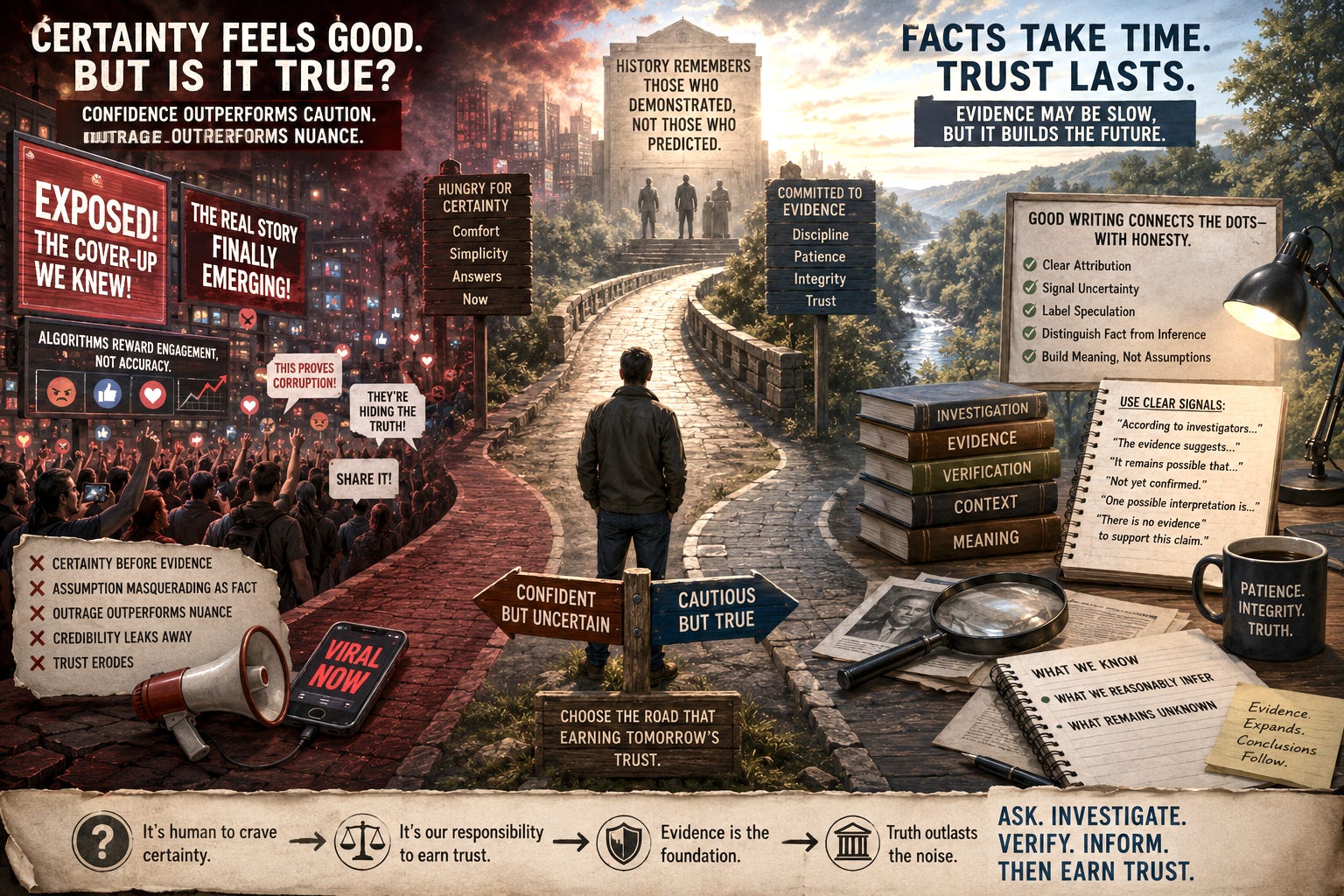
A journalist friend of mine and I keep circling back to the same question. She’s spent her career writing for fact-conscious publications. I’ve spent mine as an engineer, where conclusions live or die by evidence. And yet we both notice the same thing: writers who stay tethered to verifiable facts struggle to build the audiences that those who confidently tell readers what they suspect is happening do.
For years, I assumed people were bored by facts. I don’t think that anymore. People aren’t bored by facts. They’re hungry for certainty, and that’s a different problem entirely.
Facts arrive incomplete. They contradict each other. They shift as evidence surfaces, forcing us to live with words and phrases like probably and we don’t know yet. Certainty offers relief from all of that—it assigns heroes and villains, explains motives, and answers questions before anyone has finished asking them. Psychologists call this the need for cognitive closure: our preference for a definite answer over a lingering uncertainty. It isn’t a partisan trait. It’s a human one.
But here’s where I’d push back on my own instinct to treat that hunger as fixed. We didn’t arrive at this appetite by accident. Social media platforms don’t measure accuracy; they measure engagement. Algorithms don’t ask whether a conclusion is supported by evidence; they ask whether people will click, share, or argue. Confidence outperforms caution because the platforms built beneath us were tuned to reward it. That means the appetite for certainty isn’t something writers must simply work around forever—it’s something audiences were trained into, click by click, headline by headline. And what was trained can be retrained. If readers learned to want outrage, they can learn to want evidence again. That’s the more useful and more hopeful story here.
Imagine two writers covering the same investigation. The first writes: “Officials released several thousand pages of documents. Witnesses disagree on key details. Investigators continue reviewing additional evidence.” Every sentence is accurate, yet few readers remember it. The second writes: “The documents expose the cover-up we’ve suspected all along.” Perhaps that’s true. Perhaps it isn’t. But it satisfies something the first sentence doesn’t, and that’s the whole problem in a nutshell.
None of this means facts alone make compelling writing. Facts are evidence, not the story—readers want someone to connect the dots and explain why events matter. That’s legitimate. The failure isn’t drawing connections; it’s drawing connections the evidence doesn’t support and then hiding the seam. A few words do the honest work here: “according to investigators,” “it remains possible that,” “there is currently no evidence to support this claim.” They cost a writer very little and tell a reader exactly where the reporting ends and the guessing begins.
The real erosion happens when speculation quietly stops labeling itself. Readers who discover that certainty rested on assumption rather than evidence don’t just question the conclusion—they start questioning the writer. Credibility doesn’t vanish all at once. It leaks away, one unlabeled guess at a time.
Which is why I’d add one more thing to the mix: readers have a job here, too. We’ve grown reticent about calling out speculation dressed as fact, as if noticing the problem might be rude. It isn’t. When an article states a motive no one has confirmed or a cause no one has established, say so—in a comment, a note to the author, or a chat. I witness speculation and conjecture implicitly dressed up as facts all the time on Substack and other platforms; that’s what motivated me to write this piece. Writers respond to what gets rewarded, and right now, confidence and speculation is rewarded more than caution and verifiable facts. That only changes if readers start treating unlabeled speculation as a flaw worth naming out loud every time they see it.
I understand the appeal of certainty. The world is noisy, institutions disappoint us, and there’s comfort in believing someone finally has all the answers. But certainty bought before the evidence arrives is counterfeit. The harder path—admitting what we know, what we infer, and what remains unknown—draws fewer headlines. It also builds the one thing confidence can’t buy: trust. If I have to choose between being confidently wrong and cautiously right, I’ll take the slower road.
Facts may not win the day’s argument, but they’re the only basis on which tomorrow’s history gets written honestly.