
The Hendersons Aren't Fine — The Economics of Care
America's silent caregiving collapse and the economy that depends on it

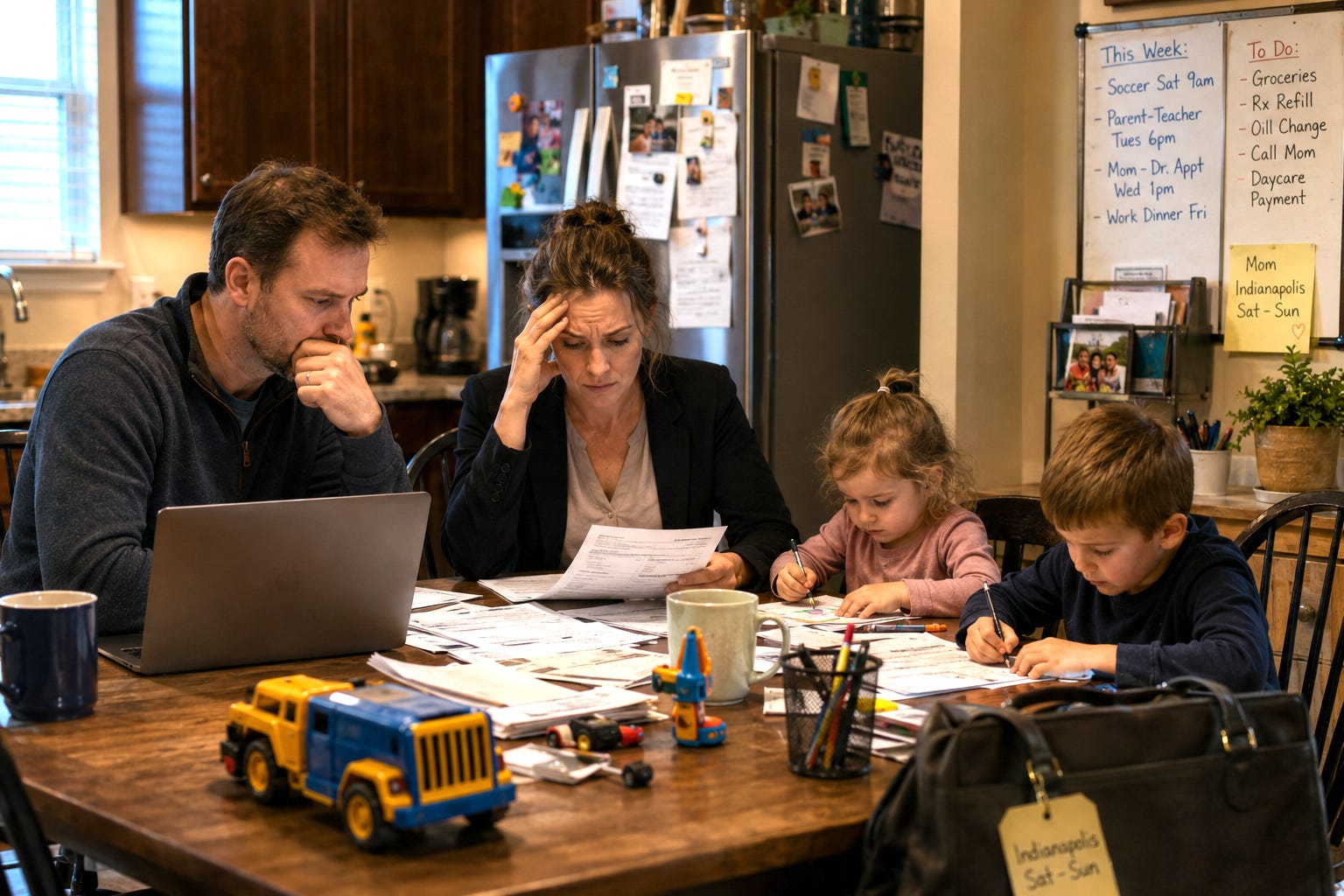
The Hendersons
The Hendersons live outside Indianapolis. She manages a regional sales territory. He’s a logistics supervisor at a warehouse forty minutes from the house. Their combined income is about $112,000 a year, which sounds comfortable until you start subtracting.
Their two-year-old is in daycare that costs $1,640 a month. Their five-year-old is in an after-school program because both parents work past 5:30. Health insurance premiums rose another 11% this year. The mortgage is fixed, thank God, but homeowner’s insurance and property taxes climbed, and the car needs new tires.
Her mother lives 180 miles away and was diagnosed with early-stage Alzheimer’s in December. They aren’t yet at the point where she can’t be alone. They’re at the point where every phone call carries a trace of fear. The stove was left on. The medication was missed. The neighbor calling on a Tuesday to ask if everything’s all right because Mom seemed confused at Kroger.
She drives north every other weekend now. He picks up the kids alone those Saturdays, gets them to soccer practice, makes sure homework is done, and manages the meltdowns. By Sunday night, when she gets home, neither of them has slept enough. By Monday morning, both are back at work, pretending they have.
GDP grew this quarter. Unemployment in their county is below 4%. The financial indicators are fine.
The Hendersons are not.
Inflation versus exhaustion
Most of the inflation discourse in 2026 still treats Americans as if the problem were prices. The grocery bill, the gas pump, the insurance premium—pick a number, watch it climb, blame the administration in power. That framing keeps missing what’s actually breaking.
The crisis families are living through isn’t primarily a pricing crisis. It’s a logistics crisis. An exhaustion crisis. A crisis over whether the daily operations of a household can be sustained by the people inside it.
Affordability used to mean: can we cover the bills? It now means: can we cover the bills while also coordinating four schedules, two aging parents, three medical conditions, two school calendars, and a job that demands availability beyond contracted hours? Money is one variable. Time is another. Cognitive bandwidth is a third. When all three break down at once, no economic indicator captures what’s happening, because the indicators were never built to measure operational collapse.
Voters keep telling pollsters they feel stretched, anxious, and beleaguered. The political class keeps reading those numbers and reaching for the inflation lever. They’re pulling the wrong lever. The underlying problem isn’t that things cost more. It’s that the entire machinery of American daily life now requires more labor to operate than the people running it can actually provide.
The hidden economy of care
In March 2026, AARP’s Public Policy Institute released its Valuing the Invaluable report. The numbers were shocking enough to make every front page.
They didn’t.
In 2024, 59 million Americans provided unpaid care to adult family members, neighbors, and friends. They logged 49.5 billion hours of caregiving. At an average market value of $20.41 per hour, that unpaid labor would have cost the economy $1.01 trillion if anyone had actually been paying for it.
Read those numbers slowly.
One trillion dollars in unpaid labor exceeded the entire federal, state, and local Medicaid budget in 2024 ($932 billion). It also exceeded what every private business in the United States spent on health care that year ($967 billion). The 49.5 billion hours of care are equivalent to roughly 24 million full-time workers—about 17% of the entire US full-time labor force.
In 2006, AARP’s first version of this report estimated the economic value of family caregiving at $350 billion. By 2021, it had risen to $600 billion. In just three years since, it has nearly doubled to a trillion. That sharp increase is driven by more people providing care, more hours spent on caregiving, and greater care intensity for each case. According to AARP, the biggest contributors were the growing number of family caregivers, the rising number of hours each person puts in, and a shift toward more medically complex cases that require higher levels of skill and commitment. The change is not the result of caregivers being paid more for the same work. It reflects more caregivers working longer hours on harder cases, in a medical system that has steadily offloaded responsibility back onto families while remaining structurally unable to fully serve them.
And this doesn’t even count childcare. AARP’s analysis focused specifically on the care of adults—it excluded the labor of raising children entirely. When economists account for unpaid childcare, the numbers become even more staggering. Estimates from the Bureau of Economic Analysis suggest that unpaid childcare provided by parents and relatives in the United States would add roughly $1.6 trillion per year to GDP if it were compensated at prevailing market rates. Add that figure to the $1 trillion in unpaid adult care, and the hidden economy of care under American GDP runs well into the multiple trillions per year.
That’s the labor America’s official economic statistics never see. It happens in living rooms. In hospital parking lots at 4 a.m. In the bathroom of an Alzheimer’s patient at 3 a.m. In a kitchen at 11 p.m., after the children have finally gone to sleep, a daughter is on the phone, helping her father navigate Medicare paperwork he can no longer read. The market doesn’t price it. The Bureau of Labor Statistics doesn’t track it. The talking heads on financial news don’t mention it.
But the country runs on it.
The workforce impact
Between January and August 2025, roughly 455,000 American women left the workforce. According to Catalyst’s national survey, 42% of those who left voluntarily cited caregiving—childcare costs, eldercare obligations, and the impossibility of holding both ends together—as the main reason. Caregiving was the top driver of women’s labor force exits in 2025.
The Guardian Life Insurance Company’s From Workforce to “Careforce” report documented an even more telling shift. As recently as 2023, women made up 56% of full-time workers juggling caregiving responsibilities. By 2025, that number had inverted: men now make up 57% of working caregivers. Not because men suddenly stepped up. Because women left the formal workforce entirely, fewer of them remain in the population trying to balance both.
Most of the press coverage of that finding emphasized rising male participation. The real story was the opposite. Women weren’t sharing the load with men more equitably. They were disappearing from the formal economy because the load could no longer be carried while also holding a job.
The childcare math no longer works in 2026. The average American family now pays $1,230 a month for infant center care. In New York City and Washington, DC, the figure runs from $2,200 to $3,000. Center-based childcare for two children exceeds the average annual mortgage payment in 45 states and exceeds in-state college tuition in 41. Federal regulators define affordable care as 7% of household income. The actual national average is over 20%. For single parents, it’s 35%. For families in DC paying for both an infant and a preschooler, it’s 51% of median family income—gone before food, rent, and health insurance.
Forty-three percent of full-time American workers now have caregiving responsibilities at home, up from 38% in 2019. Nearly half, or 47 percent, of caregivers under age 50 are in the sandwich generation, simultaneously raising children and caring for aging parents. Seven in ten working caregivers report serious difficulty balancing the two. They scale back hours. They turn down promotions. They burn through PTO covering medical appointments. They leave careers they spent decades building. The burden is not distributed equally: caregiving responsibilities often fall more heavily on women of color, immigrants, and lower-income families, who typically have less access to paid leave, flexible schedules, or financial resources that could ease the strain.
The economic cost appears in the statistics as “labor force non-participation”—a category that counts a missing worker but never asks why.
Federal law still does not mandate paid family or medical leave. The United States remains the only industrialized country without such leave. Fewer than one in four American workers has access to paid family leave through their employer. The other three-quarters are on their own.
The aging collision
This crisis is structural, and it’s going to get worse.
The Baby Boom generation—the largest demographic cohort in American history—is now entering its highest-care years. The leading edge of the Boom turned 78 in 2024. The trailing edge turns 62 in 2026. Over the next 15 years, the population of Americans aged 80 and older will grow by tens of millions. Dementia diagnoses are projected to rise sharply alongside that aging curve.
Meanwhile, the systems built to support that aging are fragmenting. Nursing home capacity has declined across much of the country since 2020, as facilities have shut down due to staffing shortages. The home health aide workforce is in chronic shortage because wages remain too low to retain workers. Medicare doesn’t cover long-term care. Medicaid covers it only after a family has spent down nearly all its assets, a structure that punishes the prudent and bankrupts the rest. In contrast, most other industrialized countries provide long-term care through national insurance or public support, making services such as home and residential care more broadly accessible. For example, nations such as Germany and Japan fund long-term care through compulsory social insurance plans, ensuring families do not face catastrophic financial strain when aging parents need assistance. Scandinavian countries provide universal access to healthcare through robust public funding. The absence of a comparable framework in the United States leaves American families uniquely exposed to both financial and caregiving burdens.
At the other end of the demographic chart, US birth rates have collapsed below replacement level. The fertility rate hit 1.6 in 2024, the lowest in American history, down from 2.1 in 2007. Fewer children mean fewer future caregivers per elderly American, so the per-person caregiving burden on Generation X and Millennials will be heavier than anything Boomers themselves had to absorb for their parents.
A 2025 American Family Survey found that 70% of Americans now say raising children is too expensive—a 13-point jump in a single year. For the first time in that survey’s 11-year history, finances became the number-one reason Americans give for limiting family size, cited twice as often as any other factor.
So the bill is coming due from both directions at once.
More people need care. Fewer people are available to give it. Care needs are more demanding because medical advances keep elderly Americans alive longer with more chronic conditions. And no national infrastructure is built to absorb any of it.
This isn’t a temporary inflationary problem with a campaign-cycle fix. This is a long-duration structural collapse unfolding in real time, across every state, every county, every neighborhood. The defining economic stress of the next decade may not be unemployment. It may be caregiving overload—and traditional indicators don’t measure it because they were never built to.
Political paralysis
What makes this politically combustible is that the public has already reached consensus. The politicians are the ones who can’t move.
Polling on caregiving and family-support policy is among the most lopsided in American political life. A 2024 BPC Action survey found that 82% of voters support a federal paid family and medical leave program, including 90% of Democrats and 76% of Republicans. A 2025 Echelon Insights poll found 83% support for congressional action on universal paid leave. An Engage poll in early 2026 found 76% of voters supporting the bipartisan More Paid Leave for More Americans Act, sponsored by Republican Stephanie Bice and Democrat Chrissy Houlahan. A 2024 national caregiving poll found 86% of voters—including 92% of Democrats and 82% of Republicans—want lawmakers to make caregiving more affordable. More than 80% of respondents supported paid family leave, caregiver tax credits, and employer incentives for caregivers.
Breaking the legislative deadlock will require strategies that make congressional action both necessary and unavoidable. Feasible next steps may include: coordinated advocacy campaigns that mobilize bipartisan coalitions of families, care workers, and employers to sustain public pressure on key committee chairs and leadership; focused media initiatives that continually connect personal caregiving stories to the legislative bottleneck; and tactical use of state-level policy successes to demonstrate both feasibility and public support. Experts also suggest legislative compromises that phase in benefits or target the most urgent needs first, providing incremental wins and momentum. In parallel, empowering employer associations and business groups to advocate for the financial benefits of a strong care policy could change perceptions of political risk. Ultimately, breaking the impasse will depend on persistent, visible demands from groups across party lines, making inaction costlier for politicians than action.
This isn’t a divided electorate. This is one of the most lopsidedly bipartisan policy areas in American politics. And yet:
The Credit for Caring Act, which would provide a $5,000 federal tax credit to family caregivers, has sat in the House Ways and Means Committee since early 2025, with no obvious path forward.
The Lowering Costs for Caregivers Act, which would allow caregivers to use HSAs and FSAs for parents’ medical expenses, has been parked alongside it.
The FAMILY Act, introduced by Senator Kirsten Gillibrand year after year for nearly a decade, has yet to reach the floor for a vote.
The United States remains the only industrialized country without a national paid family and medical leave program.
The 2025 reconciliation bill—the so-called One Big Beautiful Bill Act—did include modest improvements. It made permanent the $2,200-per-child Child Tax Credit and the 45S employer-paid leave credit, and added incremental gains. That was real progress, fairly credited to the bipartisan working groups that pushed for it. But $2,200 per child per year, when infant care alone now costs over $14,000 per year and is rising, is a partial reimbursement on a bill that keeps growing faster than the reimbursement. It’s a gesture toward the problem, not an answer.
That’s the disconnect driving populist anger across both parties. Voters look at a political system willing to debate trillion-dollar geopolitical commitments, multi-trillion-dollar tax packages, and endless culture-war legislation, and they ask a reasonable question:
Why can’t this institution do the thing that 80% of us already agree on?
The honest answer is uncomfortable. The institution rewards conflict and punishes consensus. A 90/76 bipartisan issue offers no advantage to anyone trying to differentiate themselves for the next election. It gets quietly killed in committee while the cameras roll on something more divisive. Care policy keeps losing not because it’s controversial, but because it isn’t controversial enough to be useful.
That’s a structural indictment of how American politics functions now. Voters can feel it, even when they can’t articulate it. And they’re right to feel it.
The larger thesis
The deepest argument here isn’t about policy. It’s about what America built and what America assumed.
For most of the 20th century, the American economy operated under the implicit assumption that someone would always be at home. A mother, a wife, a daughter, an aunt—an endlessly available stock of unpaid female labor performing the cooking, cleaning, child-raising, elder care, schedule coordination, and emotional management that kept households functioning while the formal economy did its visible work.
That assumption was always partly fiction. Black women, immigrant women, and working-class women of every race were in the paid workforce long before the 1970s, and the unpaid labor at home got done anyway—on top of paid jobs, by exhausted people with no margin. But for the postwar middle-class household that the entire American economic model was designed around, the assumption mostly held. The breadwinner could be available at work because someone else was available for everything else.
That foundation no longer exists.
Women’s labor force participation rose steadily from the 1960s through the early 2000s and now approaches parity with men’s. The unpaid labor at home was never redistributed. It was simply piled on top of paid work. Then aging parents were piled on top of children. Then chronic illness management was piled on top of aging parents. Then return-to-office mandates were piled on top of it all.
The economy never reorganized to absorb the change. Workplace expectations didn’t loosen. Schools didn’t extend their hours to match the workday. The healthcare system kept assuming someone at home would provide discharge care. Medicare kept assuming someone would handle rides to appointments. Employers kept assuming workers were unencumbered. Cities kept growing around two-parent households in which one parent didn’t work for pay.
The labor never went away. It was just pushed onto people who were already doing other jobs. And now, after fifty years of compounding pressure, those people are breaking.
That’s what 455,000 women leaving the workforce in eight months looks like. That’s what a 13-point jump in one year in the share of Americans saying it’s too expensive to have children looks like. That’s what 70% of working caregivers report: they can’t balance the two. That’s what $1 trillion in unpaid labor—almost certainly an undercount—extracted annually from a population that can no longer sustain it indefinitely looks like.
America built an economy optimized for productivity while quietly assuming that an endless supply of unpaid human care labor would remain in the background. Now that assumption is breaking down. When an economy’s foundational assumption breaks down, the consequences spread far before the experts on television notice.
The Hendersons aren’t living an inflation story. They aren’t living a labor-market story. They’re living the slow collapse of a contract no one ever wrote down—the contract that said someone, somewhere, would always be available to absorb whatever the system couldn’t afford to pay for. That contract is expiring in millions of households at the same time, and the people who held it up are tired in a way no quarterly indicator measures.
The political question for 2026 and beyond is whether the country’s institutions can adapt fast enough to absorb what’s already in motion, or whether they’ll keep arguing about the price of eggs while the operational basis of American family life quietly collapses beneath them.
The voters know what is happening.
Sooner or later, the politicians will, too.
Nobody ever valued the work women always did until suddenly they stopped being available to do it.
Excellent article!