
The Space Between Words
Books became both a refuge and a rebellion against a childhood marred by abuse.

This post is dedicated to my therapist, Kim Asher, who has served as a key factor in my intelligent and functional learning journey regarding dissociation, helping me become my complete self.
This is a story of surviving against all odds, a journey where books weren’t just stories but keys to another world, a world where I could find solace and strength. Growing up, my small home—even smaller when I was locked inside a wooden toy chest—became my escape to somewhere else. Anywhere else. They weren’t simply stories about other people; they were lifelines thrown to me, a drowning child. One of my earliest memories is of pain at not yet two years old. My father poured boiling water over my wrists and told my mother I had pulled a pot of soup down from the stove. This was the start of a pattern that would shape my childhood: violence followed by lies and more lies.
The human mind has powerful defense mechanisms that shield it from trauma. My memories from those years are like broken pieces, scattered like shards of glass on the street. Some memories, though few, are crystal clear. My father, in the shop at the high school where he taught, fashioned a weapon designed to cause maximum pain, featuring a fitted handle and drilled holes to reduce drag, allowing it to be swung faster and harder. Other memories bring up feelings rather than images—the terror triggered by the sound of footsteps approaching my bedroom door.
Psychologists call this phenomenon “dissociative identity,” a survival mechanism that fragments memories to protect the mind from unbearable realities. During the beatings, which sometimes happened twice a day, I would mentally detach from my body. I recall vividly one instance when I felt as though I were floating above, watching the events unfold from the ceiling, observing my small frame enduring pain that should not have been mine. When I was locked away, pushed into darkness, and left to soil myself, only to be beaten for that indignity, I would escape to another place in my mind.
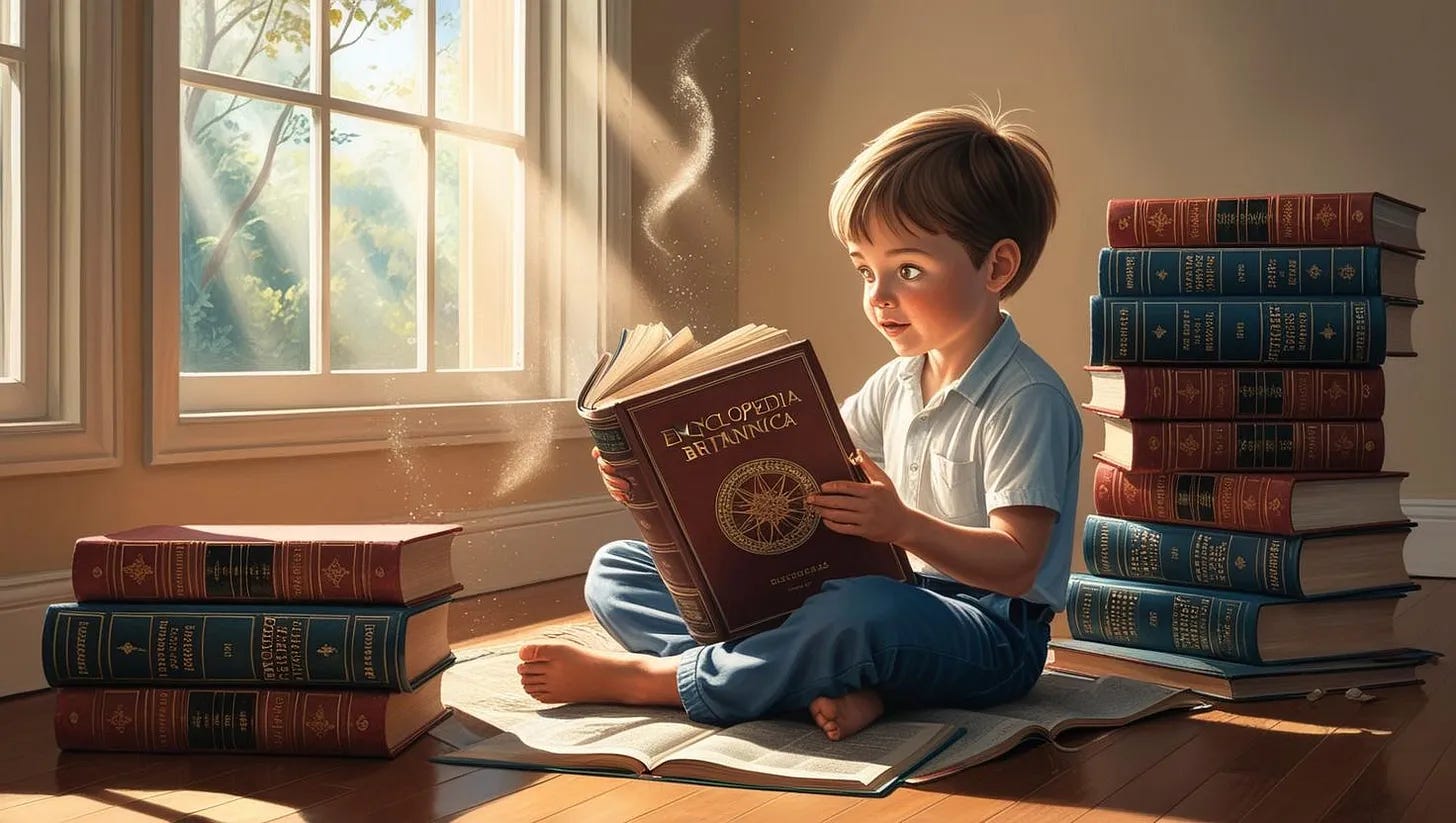
Books showed me how. Thanks to my great-grandmother, I learned to read at a remarkably early age, as if some part of me knew that knowledge would be my salvation. I still remember sitting beside her in a sunlit room, the scent of her rosewater perfume in the air as she patiently taught me the letters. Her hands, soft and warm, guided mine over the pages, connecting each shape to a sound and each sound to a word. This is how I began to understand the power of language—each book a promise of a new world. Starting at age five, I systematically worked through my grandfather’s Encyclopedia Britannica (he taught me to love reading), absorbing knowledge to use as armor. Knowledge felt safe when nothing else did. Facts couldn’t hurt me. Facts couldn’t change or turn violent without warning.
Always a quick reader, I finally took a speed test while pursuing my degree in political science at 33, clocking in at just under 700 words per minute and achieving surprisingly high comprehension scores. These days, I read more slowly, around 500 words per minute, partly due to age, medication, and cognitive changes. However, as a child, my ability to consume books at such a fast pace gave me a clear advantage in the knowledge race, allowing me to devour entire libraries of information. I remember, as a small child, finishing ‘The Wizard of Oz’ in one locked-in night, the speed of my reading granting me more worlds to escape into during those long, solitary hours.
L. Frank Baum’s Oz books were my first true gateway to the idea of dissociative identities. In Dorothy, whisked from the dull plains of Kansas to a vibrant land of magic and possibility, I saw what patriarchy denied me at home—a world where female strength could be fully realized. Baum, influenced by his wife and mother-in-law, both prominent feminists in the suffragette movement, imbued his female characters with strength and leadership. I was much more drawn to powerful, intelligent women as role models than to men. In Dorothy, I found a character transported to another reality, exactly what I longed for with every fiber of my being. I didn’t just read about Oz; I lived there for hours at a time. I walked the Yellow Brick Road, felt the poppy fields lull me to sleep, and faced the Wicked Witch with a courage I couldn’t access in everyday life. As my consciousness shifted into someone else’s skin—always the story’s protagonist—the pain in my body faded.
The biographies I devoured offered a unique form of escape. Jim Thorpe’s story especially captivated me—a Native American who overcame challenges others didn’t face to become one of history’s greatest athletes. When my father pursued me, I was no longer a captive child; I was Jim Thorpe, strong and capable, running so fast that nothing could catch me. Thorpe’s resilience and ability to transcend adversity mirrored my own need to rise above my circumstances. His story became a model of strength and perseverance, showing me that obstacles could be overcome with courage and determination.
Similarly, Madame Curie was a major hero of mine, changing how we understand the world through her scientific breakthroughs. Her fearlessness in the face of the unknown inspired me to question the world around me and seek knowledge as a means of empowerment. The courage she demonstrated in her work encouraged me to face my fears and transform adversity into opportunity. With each book, I practiced the art of becoming someone else, borrowing traits to survive my own life.
This wasn’t just escapism, although heaven knows I needed to escape. It was a form of psychological survival through radical empathy. By fully inhabiting these other lives, I kept parts of myself pure and untouched by what was happening to my physical body. I created private sanctuaries within myself where no one could follow, especially my father. Psychologists now recognize this as a sophisticated coping mechanism. Children subjected to chronic abuse often develop rich inner lives as a way to cope with ongoing trauma. What might seem like simple daydreaming or an obsession with reading from the outside can actually be the mind creating necessary psychological distance from unbearable circumstances. Dissociation saved me, but like many survival mechanisms, it comes with costs. I paid for my freedom with fractured memory. When you learn to leave yourself and endure the unendurable, fully returning to your body and identity proves a complex process. The borders between self and other, and between fact and fantasy, can and do blur.
I became skilled at reading rooms, sensing the intangible currents of emotion and intention that precede violence. This hypervigilance, common among abuse survivors, made me highly attuned to others’ moods but disconnected me from my own feelings. I could accurately read others’ feelings, but if you asked how I felt, I had to check the protagonist of whatever book I was reading for an answer. Books taught me that identities are fluid and that consciousness can shift from one person to another. In the stories I loved, characters transformed. Dorothy became a hero, Jim Thorpe became a champion, ordinary people became presidents and renowned scientists. These evolutions revealed possibilities beyond victimhood. If they could become someone else, so could I.
The turning point of my childhood was when I began to see myself as the main character in my own story rather than a background figure in my father’s narrative of control, violence, and domination. This shift happened gradually, supported by countless hours spent with characters in books who took action, changed their circumstances, and refused to accept the limits imposed by others. This led me to fight back physically, which surprised my father. My rebellion, however, is another story for another time. A few weeks before my 16th birthday, I left home. The details of that departure—how a child not yet sixteen managed to live alone while finishing high school—are stories for another time. What matters is that books had prepared me for this change in my life. I had read enough hero’s journeys to recognize when the hero must leave the familiar, no matter how terrible, and enter the unknown. Living alone during my last two years of high school proved more difficult than I had expected. Practical issues were many, including covering my living expenses and maintaining regular school attendance. Still, the psychological challenge was even greater. Lacking the constant threat of violence that had shaped my days, I had to discover who I was when not defined by survival.
Once again, books illuminated my path. I began exploring stories—not merely tales of escape and transformation, but narratives about building, creating, and becoming something new. I examined how fictional characters formed identities after loss, built connections, and found meaning in their lives. What does a life look like when fear no longer writes the plot? I embraced these lessons with passion and zeal, ready to rebuild myself from the ground up.
Modern neuroscience offers fascinating insight into what was happening in my brain during those years of literary escapism. When we read, our brains don’t distinguish much between reading about an experience and actually experiencing it. The same brain regions activate whether we are running down a street or reading about a character running down a street. For a child experiencing trauma, this neurological reality becomes a salvation. Each book and each personal story creates alternative neural pathways—experiences my brain processed as real, free from the taint of abuse. In a very literal sense, reading rewired my brain, fostering experiences of safety, agency, and possibility that countered the lessons of helplessness that trauma was simultaneously teaching. This explains why certain books and characters remain so vivid to me decades later. They weren’t simply stories; they were lived experiences during my most formative years. The emotional memories attached to them carry the same neurological weight as “real” memories because, to my brain, they were equally real. As an adult, I’ve had to learn the difference between healthy imagination and dissociative escape. The very ability that saved me as a child—the capacity to step back and observe—became problematic in adulthood when emotional presence was necessary. Relationships, in particular, demand sustained presence, which I found challenging after years of practiced absence.
The journey from dissociation to integration has not been a straight line. I’ve worked with various therapists, some helpful and some not; fortunately, I’ve found an excellent one. There have been relationships where I reverted to old patterns, becoming whoever I thought would be safe or desirable. These moments of regression, or ‘Return of the Dragon’ moments as I’ve come to think of them, are as integral to the healing process as breakthroughs. Acknowledging these cyclical returns normalizes the journey of recovery, making setbacks feel expected rather than shameful. Books have been steady companions throughout it all, although my relationship with them has changed. I no longer read to escape my life but to enrich it. The protagonists I admire now aren’t just those who survive against impossible odds; they learn to be vulnerable, connect with others, and create something meaningful from the wreckage of what was.
Literature not merely transformed my life—it gave me a life of my own. Between the words on a page, I found enough space to exist when the physical world offered no such relief. By turning the pages, I learned the most vital lesson: that stories, even the most painful ones, can be endured, and beyond mere survival lies the possibility of creating something new. Through literature, I discovered a vast expanse that gave me the freedom I desperately craved. The transition from the dark, cramped space of the toy chest to the boundless world of stories mirrors my journey from survival to self-discovery, stitching together the fragmented pieces of my life into a cohesive whole.
A notable transformation occurs when a former escapist reader begins to write. The passive becomes active; the observer becomes a creator. Writing my own story—literally through words on a page and figuratively through my personal decisions—is the pinnacle of my journey with books. The child who once disappeared into others’ stories now creates spaces where readers might see parts of themselves. The pieces of identity I collected from many protagonists have come together into something unique, not despite my fractured beginnings but because of them. I sometimes wonder what my six-year-old self, carefully working through the Britannica while dealing with emotional wounds, would think of the person I am now. I hope he recognizes that he achieved his desperate mission. The stories saved us. The words carried us through. The characters gave us their courage until we could find our own.
I believed them. Now I’m discovering and writing my own story.
"Now, I’m discovering and writing my own story." <- Kudos to you, Keith, and much respect from me. You write beautifully. Thank you for sharing your story with us.