
The Verse That Convicts Them
Conservative Christians hang their politics on three words of scripture. Jesus meant the opposite of what they’ve been taught.

Many people, regardless of their faith, have wondered how conservative Christians and Christian nationalists can call themselves Christian at all. They seem not to follow Jesus’ core message of caring for the least among us or of treating others as they would want to be treated. I’ve wondered it too, and my wonderment has nothing to do with my own faith or anyone’s lack of it. Of course, throughout history, Christian traditions have interpreted Jesus’ teachings in many different ways. There is real diversity—liturgical, doctrinal, and political—within Christianity, and I recognize that any passage from the Gospels has been read through a range of lenses. Still, what concerns me here is something I came to understand only slowly: that these self-described Christians have been taught a whole politics built on a single verse, supposedly an utterance of Jesus, and that the real meaning of that verse is very different from what they’ve been told.
This isn’t a quarrel over style, where one believer prefers grace and another prefers order, and we agree to differ. It’s a question of whether the man they claim to follow said anything like what they say he said. On the points that matter most, Jesus was neither silent nor neutral. He spoke, and what he said matters. The single passage the Christian nationalist reaches for most often to excuse himself from any duty to the least among us is the very passage that, read honestly, indicts and then convicts him.
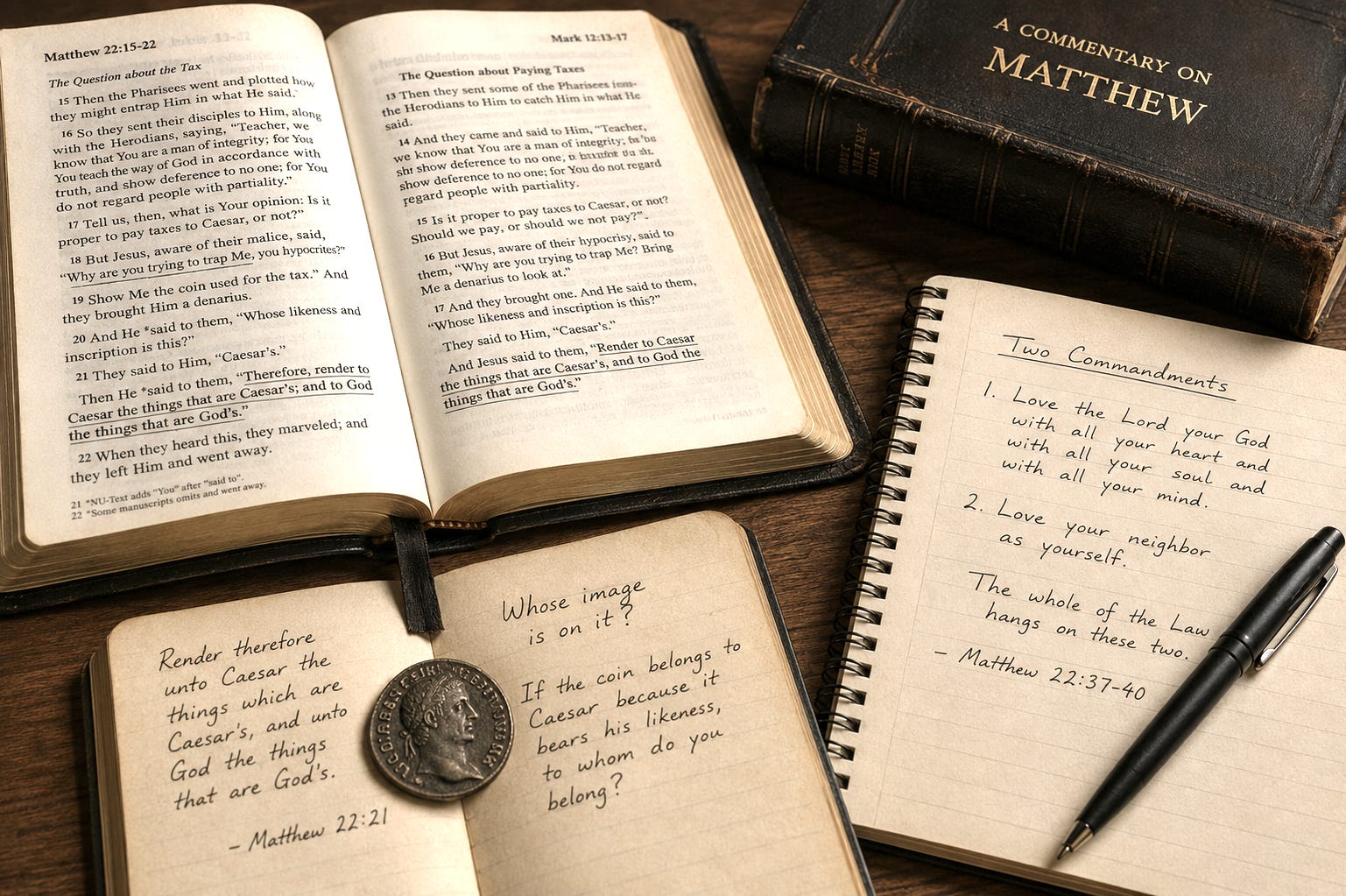
The verse they hide behind
The Christian nationalist reaches, almost reflexively, for a single line of scripture to separate the part of life he wants to control from any obligation to the least among us.
Render therefore unto Caesar the things which are Caesar’s, and unto God the things that are God’s.
Conservative Christians read it as a treaty—two sovereigns, two jurisdictions, a clean border between them. Caesar gets the public square, the money, the power, the enforcement. God gets Sunday morning. It’s a tidy arrangement, and it has the advantage of letting a man pursue worldly dominion while calling it faith.
It also completely misreads what Jesus was doing. The trap is set when the Pharisees and the Herodians hand him a Roman coin. He asks whose image is on it. Caesar’s, they say. Here, the careful reader has to slow down, because the Greek word Jesus’ questioners are made to confront—eikon, meaning image—is not neutral. It is the same word that runs through the opening of Genesis, where humanity is made in the image of God. Jesus is pointing straight at it. The coin bears Caesar’s image. Give it back to him; it’s his trinket. But you bear God’s image—and so does every person alive.
That is the whole of it. Jesus says that Caesar’s face may be on the coin—but that is the extent of Caesar’s claim. The image of God marks all creation. The so-called secular world, the world of money, power, and force, belongs to God as well. There is no realm fenced off where strength is king and the least among us can be safely ignored. Jesus does not divide the world into two. He collapses it into one and hands it all back to God.
Many biblical scholars and theologians, including N. T. Wright, Richard Bauckham, and Miroslav Volf, emphasize that Jesus’ response is deliberately subversive—a claim not about dual allegiance but about God’s primacy over all of life. Wright argues that by echoing Genesis and the Imago Dei, Jesus points to an obligation higher than any civic duty, making the passage a radical assertion of God’s ultimate claim. Bauckham notes that the story dismantles the very idea of a tidy division between sacred and earthly rule. Yet some scholars read the passage differently. For instance, Ulrich Luz and Craig S. Keener suggest that Jesus’ response recognizes the legitimate role of secular government and allows for the coexistence of religious and civic obligations. According to this reading, the saying acknowledges a distinction between the spheres of God and Caesar while keeping God’s sovereignty in view. The question Jesus leaves hanging is the only one that matters: if the coin belongs to Caesar because it bears his likeness, then to whom do you belong?
Even the evangelical scholar D. A. Carson—no one’s idea of a radical—reaches the same conclusion. He argues that if we give back to God what bears his image, we must give ourselves entirely to him; far from privatizing religion, Jesus’ saying means that God always trumps Caesar. We may owe taxes, but we owe our whole being to God. The non-canonical Gospel of Thomas even preserves a version that goes beyond Caesar and God to add a third clause—and give me what is mine—as if to underline that the dividing line was always tilted, that the accounting was never meant to come out even.
Not two kingdoms
The theologian John Howard Yoder spent his career arguing that this passage is not a two-kingdom theory or a compartmentalization of life into the sacred and the secular. The two claims in the story demand loyalty in ways that force a choice between conflicting orders. You cannot serve a politics of control on weekdays and a gospel of the least among us on the Sabbath. The first-century Jews who laid their necks bare before Pilate rather than accept Caesar’s effigies in their holy city understood this better than we do. They knew exactly where Caesar’s claim ended—at the coin—and where God’s began—at everything else.
To be fair, the two-kingdom reading is not a recent invention cooked up to flatter a political movement. It descends from Augustine’s two cities and Luther’s two kingdoms, centuries-old traditions of serious thought about how the faithful live under worldly power. Over time, these doctrines evolved. In the medieval period, church and state authorities were closely intertwined, and power was often justified by appeals to both sacred and secular mandates. The church wielded profound social and political influence, and rulers commonly drew on religious legitimacy to bolster their power, muddying the boundaries both theologically and administratively.
During the Reformation, Luther revived the idea of two kingdoms to protect believers’ consciences from political overreach, insisting that even secular rulers must answer to God’s higher law. His vision admitted a distinct spiritual realm ruled by the Word of God and a temporal realm governed by human authorities, but the boundary was meant to shield faith from coercion, not to partition compassion or excuse cruelty. In the centuries that followed, interpretations changed again: Enlightenment thinkers drew on these doctrines to justify religious toleration and the secular state, while others in the nineteenth and twentieth centuries remade the idea to accommodate the rise of nationalist governments or to support established churches, sometimes redrawing the boundaries to fit prevailing ideologies.
Yet that lineage runs counter to the Christian nationalist, not for him. Augustine’s earthly city was no object of worship; it was the lesser thing, forever judged by the City of God. Luther’s prince answered to a moral law he did not author and could not revoke. Neither man dreamed of a Caesar who was the second coming. The doctrine built to keep the two kingdoms distinct has been smuggled into the service of collapsing them, of baptizing the state and calling its cruelty holy.
So the reading that casts Jesus as a border commissioner, parceling out God’s authority and Caesar’s in equal measure, isn’t a rival interpretation with equal standing in the text. It is the reading the passage was built to defeat. The man who spent his life caring for widows, lepers, and the despised did not, in his most famous political utterance, pause to reassure the powerful that their domain was secure.
The two commandments
Strip away the buildings, the doctrines, the polity—all of it—and what Jesus said he came to teach reduces to two commandments. Love God with everything you have. Love your neighbor as yourself. He said the whole of the law hangs on these two. Not the whole of the law except for the parts about power and money and who gets to dominate whom. The whole of it. A Christianity that has somehow arrived at the worship of a political strongman, treating the state’s cruelty toward the vulnerable as the will of God, hasn’t interpreted those two commandments differently. It has discarded them and kept the pretty wrapping. You can see the challenge they still pose wherever policy denies compassion to the refugee or a congregation looks past injustice to the poor in favor of partisan power. The commandments cut against the grain, demanding what political expediency finds inconvenient: solidarity with the outsider, dignity for the weak, and love that endures even if the world never rewards it.
So here is where the argument leads. The claim that certain conservative Christian political positions are strictly biblical can be examined not merely as a matter of personal faith or preference, but as an interpretive choice with significant textual implications. Rather than representing a wholly distinct approach to the scriptures, this reading appears to focus on select passages while downplaying or omitting others—an approach that risks overlooking the Gospels’ central thematic thrust. Render unto Caesar his coin. Keep nothing else back from God, because nothing else bears God’s image. Caesar’s face is on the money. That is all Caesar ever gets. The rest—the public square, the power, the stranger at the border, the least among us, and indeed, every person—belongs to God. This interpretation is not rooted in a particular political ideology but in a close reading of the relevant biblical text. Invoking political figures or movements in support of a Christian identity, without careful engagement with scriptural context, raises significant concerns about fidelity to scripture and its core ethical message.
AMEN 🙌 you're preaching to the choir my friend. Excellent Points All 🎯 this is living in Trumistan, It will Fail. TGIF, Keith, hope you have a great weekend and will reStack ASAP 💯👍😎
👏