
The Summit and the Structure
The optics will be loud, though beneath them is the structural reality that determines outcomes. To follow the real story, focus on the underlying dynamics rather than the ceremonies.

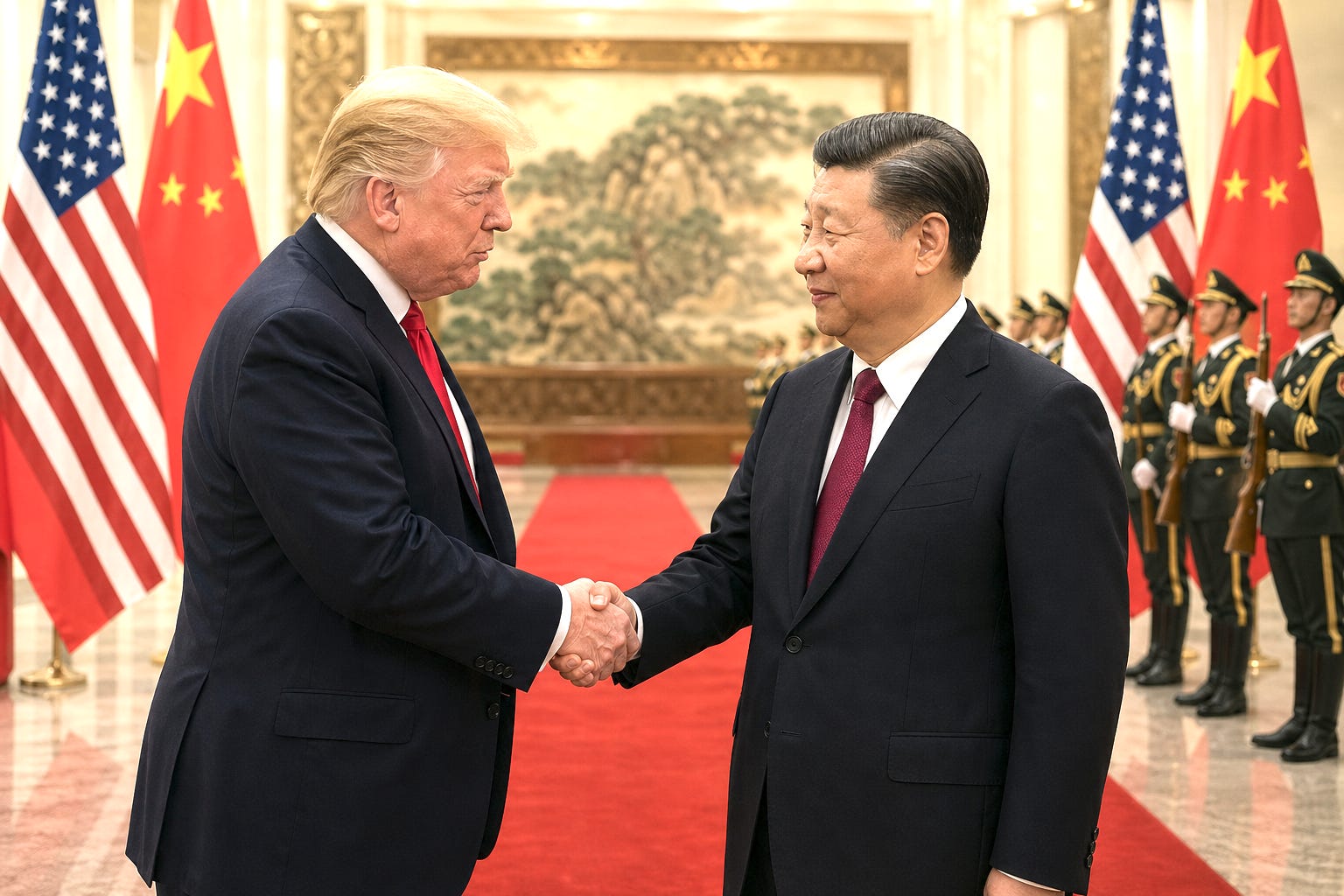
The optics will be loud. The architecture is what matters.
When Donald Trump touches down in Beijing next week with a scaled-down delegation of CEOs in tow, the cameras will capture the handshake, the pageantry, and whatever Boeing order Xi Jinping decides to announce as the price of admission. That’s the visible event. It’s also the smallest part of the story.
The real story is that China has spent years preparing for a world in which American power is less predictable, less trusted, and less institutionally disciplined—and Trump’s second term has accelerated every variable in that calculation. He didn’t create the trend, he’s pouring gas on the fire.
This piece is about what’s actually being negotiated in Beijing on May 14 and 15, 2026, and what isn’t. It’s about the difference between American capacity and American leadership, and the cost of confusing the two. It’s about Chinese leadership that has stopped trying to fit into the order Washington built and has begun building leverage to operate without it. And it’s about the smaller, harder country that sits in the middle of it all: Taiwan.
The bottom line first, then the evidence.
The United States still has immense raw power and resources, but it has damaged the alliances and institutions that once allowed it to convert that power into durable global leadership. China has built systemic challenger capacity without the alliance network, military reach, or universal appeal of a hegemon. Neither runs the system. The system itself is fragmenting into a great-power contest with no arbiter and no shared rulebook. That isn’t bipolarity. It’s something worse.
The summit Trump is bringing
Start with what the administration is actually delivering to Beijing, because it tells you everything about the asymmetry of expectations.
In 2017, Trump’s first state visit to Beijing included 29 high-profile executives and a deal package valued by the White House at over $250 billion, headlined by a $37 billion sale of 300 Boeing aircraft. This time, the White House is bringing roughly half that delegation, and the smaller size reflects administration disagreement over whom to invite. The invitation list reportedly includes CEOs from Nvidia, Apple, Qualcomm, Citigroup, and Boeing, with Boeing, Nvidia, Apple, Exxon, Qualcomm, Blackstone, Citigroup, and Visa reported across multiple outlets as the working roster.
Compare this to who’s been showing up in Beijing without the United States. British Prime Minister Keir Starmer brought 60 executives in January. German Chancellor Friedrich Merz brought 29 the following month. Trump’s delegation is smaller than what America’s allies are sending. That’s a fact worth sitting with.
The visible prize is the Boeing order. Industry reporting points to a potential package of as many as 500 Boeing 737 MAX aircraft and about 100 widebody jets, which would be the planemaker’s first major China order since 2017. CEO Kelly Ortberg has been blunt about the dependency. He told Reuters in April that without the administration’s support, no near-term large orders would emerge from China. Translation: this is a political deliverable. Boeing isn’t selling planes. The administration is.
This is what Washington wants—visible transactional wins. Beijing wants something different and bigger: the summit is expected to focus on trade, Taiwan, export controls, rare earth minerals, and the Iran war, with technology controls and sanctions relief at the top of Beijing’s list. CSIS scholar Edgard Kagan put it simply: Trump’s May visit will likely represent a relatively modest step toward greater stability and predictability in the world’s most important bilateral relationship.
Modest means optics. Optics means the underlying architecture isn’t moving.
Mutual hostages
The relationship between Trump and Xi to be discussed in Beijing isn’t a relationship. It’s a hostage exchange.
The United States can hurt China through semiconductor controls, pressure on dollar clearing, financial restrictions, market-access restrictions, sanctions, aircraft-licensing restrictions, and tariffs. China can hurt the United States through rare-earth controls, supply-chain choke points, market access, retaliation against US firms, pressure on Taiwan, and an increasingly explicit willingness to challenge the legitimacy of American sanctions.
Both sides spent 2025 learning what those weapons actually do. Both sides paid. Neither found the price acceptable. The October 2025 Busan truce wasn’t peace—it was a ceasefire built on the recognition that mutual escalation was costing more than either leadership was willing to absorb.
But the truce didn’t end the underlying competition. It simply shifted it to different channels. Both governments are using the lull to insulate themselves against the next round. Washington is building redundancy in critical supply chains. Beijing is building markets that don’t require American demand and tools that don’t require American consent.
The numbers from early 2026 tell the story. In the first two months of 2026, China’s exports grew 21.8% year-over-year, reflecting a reorientation toward non-US markets. Even after the truce reduced tariffs, Chinese exports to the US continued to fall, down roughly 11% year over year in early 2026. The decoupling is unfolding beneath the diplomatic vocabulary. Both capitals are pretending it isn’t, because both still need the other to behave.
That’s the equilibrium Trump and Xi are protecting in Beijing. Not partnership. Survival of the truce.
Rare earths: the cleanest example of the new playbook
If you want to understand what’s actually changed in the US-China relationship, don’t watch the summit. Watch the rare earth file.
In April 2025, China imposed export controls on seven heavy rare earth elements and related magnets. The impact on US industry was immediate. Ford shut down production of its Explorer SUV at its Chicago plant for a week in May due to a rare-earth shortage. Carmakers across the United States and Europe struggled to obtain permanent magnets, with some forced to cut utilization rates or temporarily shut down factories. The supply chains that underpin US manufacturing weren’t just exposed—they were operationally hostage to a Chinese licensing system that could throttle output on a regulator’s whim.
Then, on October 9, 2025, Beijing went further. The new notice required Chinese and foreign exporters to obtain Chinese government approval to export dual-use items containing even trace amounts of certain Chinese-origin rare earths. The new regime added five more elements to the controlled list, imposed a 0.1% de minimis rule, and—for the first time—asserted extraterritorial jurisdiction over goods made anywhere in the world using Chinese rare earth technology, with semiconductor- and AI-related devices and components in the crosshairs.
The design of those controls is what matters. It marked China’s first application of the re-export, de minimis, and foreign direct product rules, which the US largely uses. Beijing reverse-engineered the legal architecture Washington has used for decades to enforce its export regime, then turned it on the Americans. China didn’t just retaliate. It cloned the weapon.
After Trump threatened a 100% retaliatory tariff and the parties negotiated in Busan, China agreed to suspend the latest round of rare-earth export controls for one year, in exchange for a one-year suspension of the US’s 50% ownership rule. The April 2025 controls remain in place. The October 2025 controls are paused, not repealed, with a one-year window until November 2026. The threat is now a permanent feature of the relationship, not an episode.
This isn’t traditional diplomacy. It’s supply-chain coercion delivered with a smile and a press release. The IEA—not exactly a propaganda outlet—calls it what it is: a development that could have a dramatic impact on global supply chains, as many strategic sectors rely on products containing the controlled Chinese rare earth elements, including energy, automotive, defense, semiconductors, aerospace, industrial motors, and AI data centers.
The lesson Beijing drew from 2025 is that it can crater the American manufacturing sector in a month and bring the President of the United States back to the negotiating table. The lesson it’s now generalizing is that the architecture of American economic statecraft can be inverted and used against its inventor.
The blocking order: when sanctions become an obedience test
If rare earths show how China can hurt the United States economically, the May 2 blocking order shows something more dangerous: how Beijing intends to challenge American legal authority itself.
Here’s what happened. The US Treasury has spent the past year sanctioning Chinese refineries—including, on April 24, Hengli Petrochemical (Dalian), China’s second-largest independent refinery and a major buyer of Iranian crude—for buying Iranian oil. The sanctions cut the targeted refineries off from the US financial system and threatened secondary sanctions against any entity that transacts with them.
On May 2, 2026, China invoked a 2021 statute it had never used before. The Ministry of Commerce stipulated that the US sanctions on Hengli and four other refineries shall not be recognized, enforced, or complied with. Companies operating in China are now legally prohibited from honoring the American sanctions. If they comply with Washington and a Chinese counterparty suffers a loss as a result, they can be sued in Chinese courts and have their Chinese assets seized.
Pause to consider what this means for any global firm with exposure to both jurisdictions. Comply with Washington and risk Beijing. Comply with Beijing and lose access to the US financial system. Pick one. The Stephenson Harwood legal team described the predicament with admirable understatement: on the one hand, they need to comply with US sanctions to avoid penalties; on the other, Chinese law may restrict them from following those same sanctions.
A Foundation for Defense of Democracies fellow called it unprecedented—a major escalation in China’s response to US economic statecraft. That’s not hyperbole. For four decades, the rest of the world has obeyed US sanctions because the cost of disobedience was the loss of dollar access. Beijing has now made disobedience legally compulsory within its own jurisdiction. The question of which government’s law a firm has to follow has become a live one. That question has only one previous answer.
The blocking order doesn’t just defy Washington. It tests whether Washington’s sanctions still function as they did in 2015 or 2020. Beijing is betting that for at least some firms—Chinese state-linked banks, mid-tier traders, energy companies that aren’t deeply exposed to US markets—the answer is no. If that bet pays off, the most powerful tool in American economic statecraft starts losing its edge. Not because Washington stopped using it, but because Beijing has made it costlier to obey than to ignore.
That’s the prize Xi is defending. Watch carefully whether the post-summit communiqué mentions sanctions at all.
Taiwan: ambiguity by erosion
The most dangerous near-term test of the relationship isn’t trade. It’s Taiwan.
China has repeatedly and publicly signaled that Taiwan can’t be avoided in Beijing. In a February 2026 phone call, Xi told Trump that the Taiwan question was the most important issue in China-US relations and urged Washington to handle arms sales with prudence. Secretary of State Marco Rubio confirmed last Tuesday that Taiwan would be on the summit agenda.
The risk isn’t that Trump formally abandons Taiwan in one meeting. The risk is more insidious—and more likely. It’s the risk of ambiguity by erosion: fewer arms sales, softer language, private assurances, and a reduction in defense cooperation traded quietly for an aircraft order. Brookings analysts warn that Xi may seek changes in US declaratory policy, including on Taiwan’s legal status, and may ask Trump to constrain American arms sales.
Trump has already lit the fuse on this risk himself. In February, after he told reporters he was discussing Taiwan arms sales with Xi, analysts pointed out that the comment may have violated the Six Assurances, US policy principles formulated in 1982 under President Ronald Reagan—specifically the assurance that Washington would not consult Beijing about arms sales to Taipei. Reagan’s principle was simple. Forty-four years of presidents kept it. Trump broke it in a single press gaggle.
The Diplomat’s analysts have laid out Beijing’s calculation in precise terms. A grand deal over Taiwan or a fundamental shift in Washington’s One China policy is unlikely. But Trump’s incoherent personal language about Taiwan—or any delay in arms sales—would constitute a Beijing win without a treaty. Xi doesn’t need a formal concession. He needs erosion. Every ambiguous Trump statement, every delayed arms package, every quiet adjustment in service of a soybean deal is a brick out of the wall.
The stakes here aren’t abstract. Taiwan is a democracy of 23 million people and the center of the advanced semiconductor ecosystem on which the US economy and US military increasingly depend. Taiwan’s military spending rose 14% to $18.2 billion in 2025, equivalent to 2.1% of GDP, marking its largest annual increase since at least 1988. Aircraft incursions around the island climbed from 380 in 2020 to a record 5,709 in 2025. The pressure is real. Whether Washington will hold the line is no longer settled in Taipei, in Beijing, or in Washington itself.
Trump’s confidence in his personal relationship with Xi is the variable Beijing is counting on. CSIS analysts have flagged a broader concern in Taipei, that Trump will negotiate with Xi on arms sales to Taiwan, undermining one of Reagan’s Six Assurances. They’re not paranoid, they’re paying attention.
Iran: China’s free ride
The other shadow over Beijing is Iran, and on this file, China is the clear beneficiary of American overextension.
The Iran war that began on February 28, 2026, has done predictable damage to the global economy. The IMF cut its 2026 global growth forecast to 3.1%, down from 3.3% before the war. Iran’s outlook saw one of the largest country-level revisions, dropping 7.2 points to a forecast contraction of 6.1%. Headline inflation forecasts rose 0.6 points to 4.4%. US gasoline prices have continued to climb.
Now look at where China sits in this. Beijing has a 25-year strategic partnership with Tehran, signed in 2021, which made China the largest single buyer of Iranian oil. The war has disrupted that relationship and threatened Chinese energy security. But China has borne no military cost. It hosted Iran’s foreign minister last week and pressed for the reopening of Hormuz. The Chinese statement called for the prompt resumption of shipping traffic through the Strait of Hormuz—a position that aligns with Chinese energy interests and conveniently makes Beijing look like the responsible adult while Washington carries the bombs.
This is what a free ride looks like. The United States is paying the military, oil-market, and political costs of confronting Iran. China is paying nothing, criticizing the sanctions regime from a posture of wounded pluralism, buying discounted oil, and now positioning itself as a peace broker. CSIS analysts note that Iranian Foreign Minister Abbas Araghchi’s recent visit to Beijing signals China’s intent to weigh in on reopening the Strait of Hormuz.
If Hormuz reopens before the summit, Xi gets credit. If it doesn’t, Trump owns the energy crisis. Either way, China gains. That’s not strategic genius. That’s geographic and structural luck, which Beijing has been disciplined enough to exploit.
The deeper irony is that the Iran war has accelerated a trend that would otherwise have taken years. Asia’s rearmament is now visible in the data. Military spending in Asia and Oceania reached $681 billion in 2025—the largest annual rise since 2009. Allies are arming themselves not because they’re confident in American protection, but because they’re not.
The hegemony question, reconsidered
Hegemony isn’t only about military spending. It isn’t only about GDP. It isn’t only about the number of aircraft carriers. Those things are necessary. They aren’t sufficient.
Hegemony is trust. It’s predictability. It’s the willingness of allies to coordinate, of competitors to comply, and of bystanders to assume the system works better with the United States at the center than without it. It’s the soft architecture that turns hard power into a platform other countries want to plug into. Without that soft architecture, raw power doesn’t disappear—it just becomes a threat instead of a service.
By hard metrics, the United States still leads the world by margins so large they’re easy to miss. At $954 billion, US military spending was 7.5% lower in 2025 than in 2024—but it remained nearly three times China’s $336 billion, which itself marked the 31st consecutive year-over-year increase in Chinese military expenditure. The Pentagon has requested about $1.5 trillion in defense spending for fiscal 2027, the largest request in history. The dollar remains central to global reserves and transactions. American AI firms are still at the frontier. American universities are still where the world wants to send its best students.
But the soft architecture has cracked. The cracks are documented and intentional.
In January 2026, Trump signed a memorandum directing the United States to withdraw from 66 international organizations, including 31 UN entities and 35 non-UN bodies spanning climate policy, human rights, development assistance, and conflict prevention. The administration’s National Security Strategy made the retreat from primacy explicit. The Stimson Center summarized the official position: the days of the United States propping up the entire world order like Atlas are over. Even Marco Rubio, the Secretary of State, has acknowledged that multipolarity is inevitable—a position that would have been unthinkable for a Republican Secretary of State a decade ago.
Brookings’s Daniel Hamilton has summarized the pattern with admirable precision: Trump is testing and reshaping the foundations of the postwar order by treating long-standing relationships as transactional rather than as real commitments.
That distinction—transactional rather than real commitments—is key to understanding why allies are hedging. When the United States threatens the territory of NATO members, abandons the international institutions it built, treats trade as extortion, treats treaties as optional, and treats courts as obstacles, it stops being a hegemon and starts being a hazard. China doesn’t need to be loved to gain ground in this environment. It only needs America to become less trusted and America is doing that work itself.
The verdict isn’t that the United States is a failed hegemon. It’s that the United States is a retreating one—and the retreat is driven by political choice, not material constraint. That distinction will matter when historians, decades from now, try to figure out how a country with this much capacity managed to surrender this much position so quickly.
China’s strength, China’s brittleness
China is the most credible peer competitor to the United States since the fall of the Soviet Union. It’s also more brittle than the headlines suggest.
The strength is real and shouldn’t be minimized. In 2023, China’s manufacturing value-added reached $4.66 trillion, 28% of the global total, more than the next three largest manufacturing economies combined—the United States, Japan, and Germany. Beijing controls the dominant share of global rare earth supply and processing. Its navy is now the world’s largest by ship count. Its institutional footprint—through BRICS expansion, the Shanghai Cooperation Organization, and bilateral investment—has grown faster than American withdrawal can be measured.
China has deliberately chosen not to seek hegemony in the American sense. Foreign Minister Wang Yi stated in March 2026 that China will never take the beaten path of seeking hegemony as its strength expands. That’s diplomatic language, but it’s also an accurate description of strategy. Beijing has no formal alliance system, by design. Its plan is to constrain American hegemony and carve out spheres of autonomous influence—not to underwrite the global order as Washington has done.
That choice is part of what makes China powerful in the current moment. It doesn’t carry the obligations a hegemon does. It can pick its fights and skip the ones that don’t pay. The United States has spent eight decades extending security guarantees, paying for global public goods, and absorbing systemic risks. China is exploiting the option Washington never gave itself: refusal.
But the brittleness is real too, and it’s worth being honest about. China faces weak domestic consumption, a property sector that hasn’t recovered, demographic decline, the risk of capital flight, youth unemployment that the regime stopped publishing for a year because the numbers were too embarrassing, and a political system that punishes bearers of bad news. The IMF has repeatedly cut its long-term growth projections for China. In April 2025, the IMF projected China’s GDP would reach $23.1 trillion by 2030—much more conservative than the $27.5 trillion forecast from April 2023.
Xi’s China is powerful, capable, and strategically disciplined. It’s also working with a deteriorating economic foundation. Both things are true. The country isn’t ten feet tall. It’s also not collapsing on schedule, the way American China hawks kept predicting in the 2010s. It’s something more complicated and more durable: a serious adversary with serious problems, neither of which Washington can wish away.
Fragmented multipolarity
So what’s the actual shape of the international system in May 2026?
It isn’t unipolar anymore. The United States no longer serves as the system’s underwriter, and few countries treat it as one. It isn’t bipolar either, despite the convenience of that frame. China lacks the alliance network, military projection, and ideological appeal to serve as the second pole in a stable two-power system. And third-party players are too consequential to be reduced to satellites.
Europe is rearming, using its regulatory power and market size to set global standards independent of both Washington and Beijing. Japan elected a right-wing nationalist government and is accelerating its remilitarization—Japan’s military expenditure rose 9.7% to $62.2 billion in 2025, equivalent to 1.4% of GDP, the highest share since 1958—while building security coalitions across Asia that signal no two-power deal will settle the region. India remains officially non-aligned and increasingly consequential, intent on preventing either Washington or Beijing from dictating its regional outcomes. South Korea, Australia, and the Philippines are arming faster than at any point in their post-war histories. Regional powers like Indonesia, Saudi Arabia, Brazil, and Turkey are exercising autonomous diplomacy that no one in Washington can credibly overrule.
What this looks like, taken together, is what the diplomatic class has begun calling fragmented multipolarity—an arrangement of great-power competition without great-power governance. There’s no arbiter, no shared rulebook, and no consensus mechanism to resolve disputes that don’t neatly fit into the bilateral US-China framework. The Foreign Policy analysis is correct in its forecast: the net result is likely to be a weaker, more Chinese-dominated world order, in which powers committed to liberal values find themselves on perpetual defense.
That isn’t China replacing America. It’s the world losing the American center—and the gravitational reorganization that follows.
Many countries don’t want Chinese domination. They have good reasons. Beijing’s coercion, surveillance exports, debt leverage, territorial claims, and authoritarian export model give them every reason to hedge. But they’re hedging against Washington too, because Trump has made American policy feel personal, reversible, and punitive. That’s brutal symmetry, and it’s not an accident. It’s the natural response to a hegemon that has stopped behaving like one.
What Trump is bringing back from Beijing
The likely outcomes of May 14 and 15 are roughly as follows.
A symbolic Boeing order, possibly large and almost certainly framed as a record. An extension of the trade truce, with selective tariff relief on both sides. A renewed commitment to soybean and agricultural purchases. A “Board of Trade” framework that institutionalizes managed commerce without addressing structural decoupling. Possibly a restart of military-to-military communication channels. Possibly an opening for AI risk dialogue, though don’t bet on it.
What won’t happen: a fundamental resolution of the technology war. A guarantee on Taiwan that holds beyond the next news cycle. A breakthrough on the sanctions regime. Any meaningful constraints on China’s rare-earth leverage. Any honest American discussion of what the country has lost in the past sixteen months by treating its alliance system as a cost center.
The base case, according to one veteran China hand, is what CNBC reported: the meeting will most likely solidify the advantages China has gained over the past year. The truce holds. Beijing pockets the symbolic respect of a state visit and the implicit acknowledgment that it can no longer be coerced on the terms Washington once assumed. Trump pockets the deals he can put on cable news. The trajectory continues beneath.
The dangerous case is deterioration. If Iran flares back up, if Taiwan tensions spike, or if Trump perceives personal disrespect—especially the optical risk of comparable Beijing pageantry for Vladimir Putin shortly after his departure—the audience cost of cooperation rises, and the equilibrium destabilizes. The guardrails that kept 2025 from becoming a real trade war are thinner now than they were a year ago.
The grim case nobody wants to think about is miscalculation. Both governments have incentives to avoid escalation, but the institutional guardrails that once prevented unintended crises—shared norms, reliable communication channels, and mutual understanding of red lines—are weaker than they’ve been since the 1970s. Taiwan and the cyber/AI domain are the most obvious places where a misread signal could escalate quickly. Neither leader wants war. Neither leader has full control over the systems below them that could start one.
The verdict
Here’s what’s true.
China has a strategy for a post-American order. It has been building it for at least a decade. It has invested in supply-chain leverage, sanctions architecture, alliance hedging, and the institutional alternatives a serious challenger needs. The strategy isn’t benevolent. It isn’t democratic. It isn’t admirable. But it’s coherent.
America has power. America has more raw capacity than any country on the planet, by margins that should be embarrassing to anyone claiming the country is in decline. But under Trump, the United States has confused dominance with leadership and treated the latter as optional once the former is secure. It isn’t. Leadership is what made dominance work. Without leadership, dominance becomes mere weight—heavy, expensive, and increasingly resented.
The May 14 summit won’t fix that. It can’t. The pageantry will be the pageantry. The Boeing deal will be the Boeing deal. The communiqué will say what communiqués say. None of it changes the underlying arithmetic.
China is gaining ground because it’s disciplined enough to exploit the vacuum left by the United States, which confuses dominance with leadership. That’s not a moral judgment about Beijing. It’s an observation about Washington. The vacuum was created in Washington. The exploitation is happening in Beijing. Both halves of that sentence are American responsibilities to fix.
Until they’re fixed, the optics of summits will keep getting louder, the drift will keep accelerating, and the gap between American capacity and American position will keep widening. The world will not become Chinese-led. It will become less American-led. That distinction matters. Many people will live and die within it.
We are watching the slow, deliberate dismantling of a system the United States built, fought for, paid for, and once led. We are watching it from within the country that carried out its own dismantling. The question that should haunt every American reading this isn’t whether China is winning. It’s whether the United States understands what it has chosen to lose—and whether anyone in Washington has the discipline and intelligence to choose differently.
The cameras will go to Beijing on May 14. The bottom line is being written somewhere else.
Exceptional article. Most enlightening.
Trump will do to Taiwan what he tried to do to Ukraine. Fail to send arms but pretend you will. Pretend you are trying to protect the underdog while you are selling them out.
As to the erosion of the US in terms of allies and world position, Trump seems to be doing it all on purpose in accord with Putin's playbook.
Great points all around. Not sure how much longer China's teapot refiners can survive on high oil costs though. There's also a lot of domestic pressure in China's economy (particularly its residential property market). So China is not operating from a position of pure strength.
The U.S. also slapped sanctions on three Chinese companies that allegedly provided satellite imagery to Iran of U.S. military activities in the Middle East -- all ahead of Trump's upcoming trip. Wondering if Trump will use that as negotiating leverage (more sanctions could be applied to hurt China, particularly in banking and energy markets where it's completely import dependent).
So Trump does have some leverage, but China probably has the upper hand with rare earths alone.
I wrote about the sanctions that hit late last week in case you missed that. But overall great insights, Keith.
https://substack.com/home/post/p-197052537